Layering and Outerwear for Tall Women: Proportions That Finally Work
The jacket fits in the shoulders. The sleeves stop two inches above your wrist bone. You buy the next size up, and now it fits nowhere except the sleeves. If you’re 5’9” or taller, that fitting-room loop is the entire outerwear experience — and it isn’t your proportions that are wrong.
Quick Answer: For tall women, layering works when you shop for length first and fit second. Look for coats hitting mid-thigh or longer, sleeves that reach the wrist bone with your arm hanging straight, and base layers at least 2–3 inches longer than standard so they don’t ride up. Cropped jackets read even shorter on a long frame, so pair them deliberately with high-rise bottoms or skip them entirely.
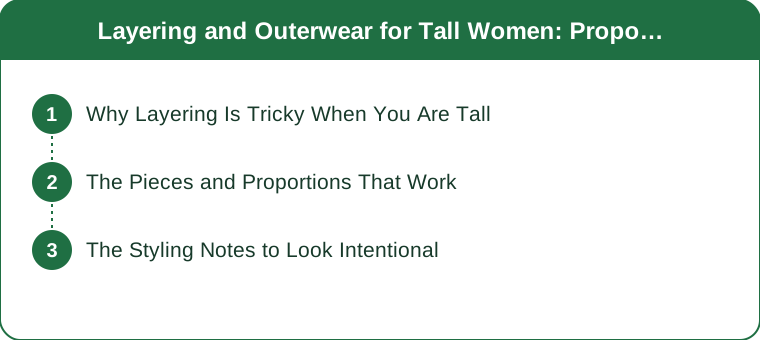
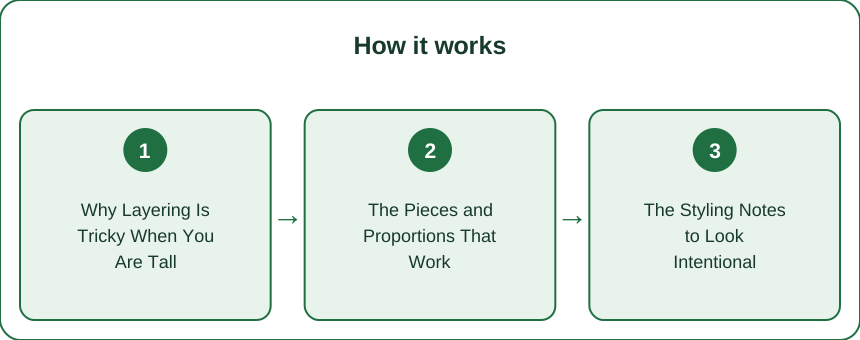
Why Is Layering So Hard When You’re Tall?
Standard outerwear is graded from a fit model who’s usually 5’6” to 5’8”. Every measurement scales up when you size up — chest, waist, hips — but sleeve and body length scale up the least. That’s why sizing up fixes the sleeves by half an inch and ruins the shoulders by two.
Four specific things go wrong:
- Sleeves fall short. A jacket sleeve should end at your wrist bone. On a tall frame, standard sleeves land mid-forearm, which reads as “borrowed.”
- Hems land in the wrong place. A coat designed to hit mid-thigh hits high-thigh, cutting your leg line at its widest point.
- Cropped styles read even shorter. A jacket cut to sit at the natural waist sits above it on a long torso, exposing a strip of base layer you didn’t plan for.
- Mid-layers ride up. A long torso means every tucked or half-tucked layer creeps upward over the course of a day.
None of these are fit problems in the usual sense. They’re length problems wearing a fit problem’s clothes.

Which Coat Lengths Actually Work on a Tall Frame?
Long ones. This is the rare styling rule where the tall frame has a genuine advantage — long-line coats, dusters, and maxi trenches need height to hang properly, and on shorter frames they often swallow the wearer whole.
The lengths worth owning:
- Mid-thigh (about 34–36 inches from shoulder): the everyday workhorse, works over both trousers and dresses
- Knee-length (38–40 inches): the polished option, best in wool or a structured trench
- Below-knee or maxi (42+ inches): the statement layer, unbeatable in a long-line wool coat or duster
- Longer moto or utility jackets: the alternative to cropped, hitting at the hip bone rather than the waist
What to avoid isn’t a style so much as a measurement — anything landing at the exact widest point of your hip, which visually chops the longest, best line you’ve got.
How Do You Check Sleeve and Body Length Before Buying?
Take three numbers and shop with them. Most brands publish garment measurements; the ones that don’t are telling you something.
- Your sleeve length: measure from the shoulder seam of a jacket that fits, down the outside of the arm to the wrist bone. Tall frames commonly need 25–27 inches versus a standard 23–24.
- Your ideal coat length: measure from the shoulder to where you actually want the hem. Write it down and compare it to the listed “back length.”
- Your base-layer minimum: measure a top that never rides up, shoulder to hem. Anything shorter than that number will ride up.
Look for tall proportions in labeled tall ranges, but verify with the numbers — “tall” is a marketing category, not a standard, and it varies by four inches between brands.
Myth vs Fact
Myth: Long coats overwhelm you, so tall women should stick to shorter jackets. Fact: Backwards. Long coats need vertical space to hang correctly, and a tall frame supplies it. The overwhelmed look comes from volume without structure, not from length.
Myth: Sizing up fixes sleeve length. Fact: Sleeve length grows roughly half an inch per size, while chest grows two. You’ll run out of shoulder before you run out of sleeve.
Myth: Tall women shouldn’t wear anything cropped. Fact: Cropped works when it’s paired with a genuinely high-rise bottom so there’s no gap. The problem is the gap, not the crop.
Myth: A belt is a must for defining the waist on long layers. Fact: Optional. A belt adds shape, but a tonal column of the same color elongates just as effectively, and sometimes more.
How Do You Style Layers So They Look Intentional?
The goal is a look that reads as a choice rather than a compromise. Four things get you there:
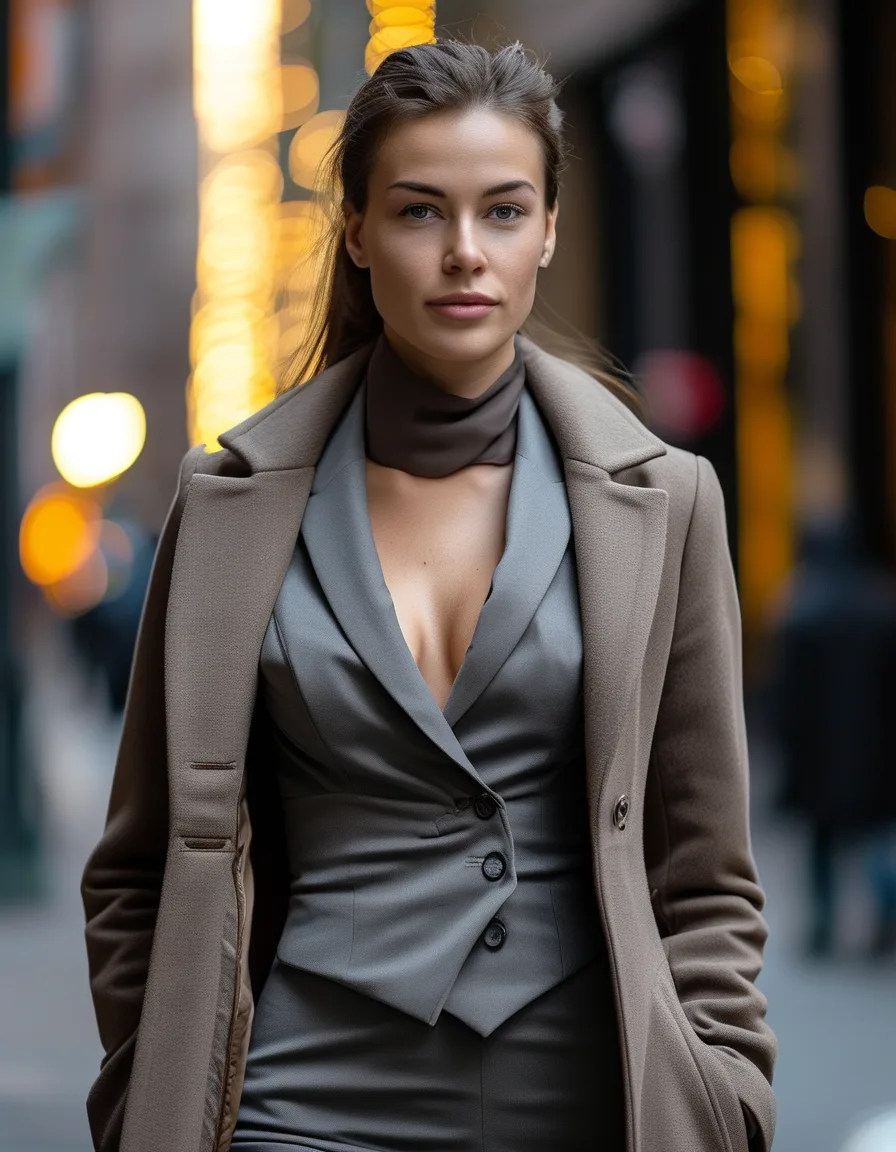
Balance fitted and flowing. A slim base layer under a long, open coat creates one uninterrupted vertical line. Volume on volume is where tall frames actually do get overwhelmed.
Try a tonal column. Same color family from neck to shoe, with the coat as a tonal layer over it. It’s the fastest way to make an outfit look expensive and deliberate.
Keep layers open. An unbuttoned coat over a fitted base creates two long vertical lines down your front. Buttoning it up creates one wide rectangle.
Scale your accessories. A tiny crossbody on a 5’11” frame looks like a keychain. Size up in scarves, bags, and boot shafts to match your proportions.
Underneath it all, a long-line base matters more than the coat does. A high waist legging with a genuinely long rise, or a longline top cut for tall proportions, means nothing rides up when you take the coat off — which is the moment most layered outfits fall apart.
For the full picture on getting your foundation layers right, the balanced proportions guide covers what to measure first.
FAQ
What coat length is most flattering if I’m 5’10” or taller?
Mid-thigh to knee is the safest range, roughly 36–40 inches of back length. It clears the widest part of the hip and keeps your leg line unbroken, which is where the height advantage lives.
Are “tall” size ranges actually longer, or just marketing?
Genuinely longer at most established brands — typically 1.5–2 inches added to sleeve and body length. But it varies enormously, so check the published garment measurements rather than trusting the label.
How do I stop mid-layers from riding up under a coat?
Buy base layers 2–3 inches longer than standard, choose styles with a longer rise, and prefer knits with some weight to them. Thin, short jersey tops are the worst offenders because there’s nothing anchoring them.
TL;DR:
- Sleeve length should reach your wrist bone — tall frames usually need 25–27 inches, not the standard 23–24
- Long coats (36–40 inches back length) are the tall frame’s advantage, not a risk
- Avoid hems landing at your widest hip point; that’s what breaks the line
- Size up only for fit, never for length — sleeves grow half an inch per size, chest grows two
- Base layers need 2–3 extra inches or they ride up under everything
- Balance a fitted base with a long open layer; scale accessories to match your frame
Layering stops being complicated the moment you shop by measurement instead of by size label. Get the lengths right, keep one long vertical line running through the outfit, and stand tall in it — the proportions were never the problem.
Keep Reading
This article is for general informational and styling purposes only. Fit, sizing, and product availability may vary — check current details before purchasing.