Why Tall Sizing Goes Wrong at the Knee Before the Hem
Quick Answer: Tall sizing usually adds length at the hem and sometimes the rise, while leaving the knee position where it was on the regular fit. The result is a trouser whose narrowest point, or whose shaping and break, sits above your actual knee. That mismatch is what makes an otherwise correct-length garment look wrong, and it is why hem length alone is a poor test.
The inseam is right. The waist fits. The length is finally correct.
And something is still off, in a way you cannot name.
Look at where the trouser is narrowest, and then look at where your knee is.
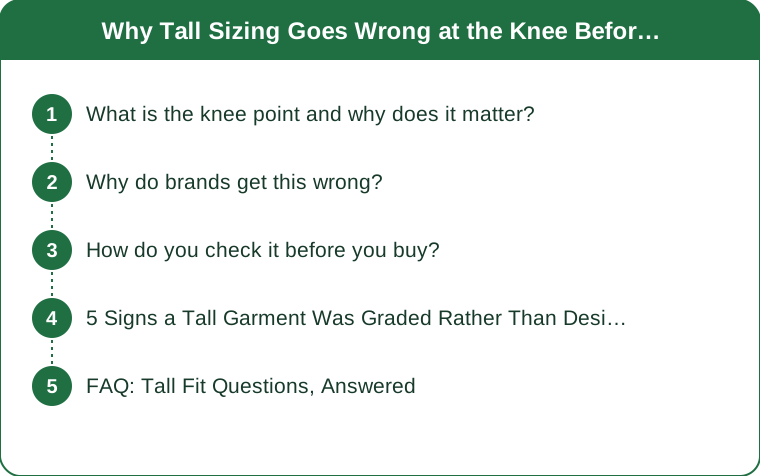
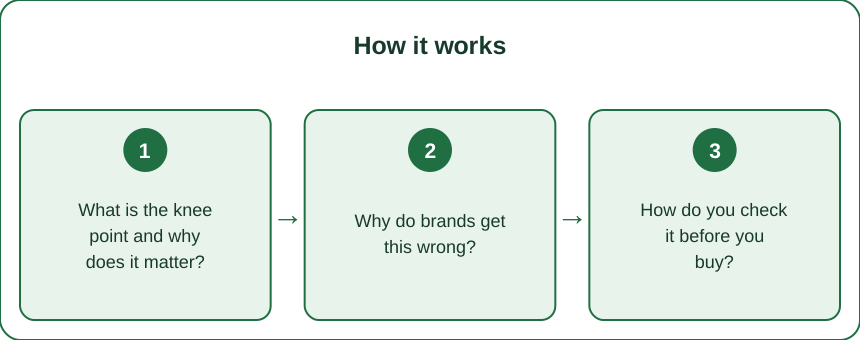
What is the knee point and why does it matter?
The knee point is where a garment’s shaping is engineered to sit, and almost every trouser has one.
In a tailored trouser it is where the leg is at its narrowest before flaring or straightening to the hem. In a bootcut it is where the flare begins. In jeans it is where the whisker and shaping are placed and, on a slim fit, where the fabric is cut with slightly more room to allow bending.
When that point aligns with your actual knee, the garment moves with you and the visual line reads as intentional. When it sits two or three centimetres too high — which is what happens when a brand adds all its extra length below the knee — three things follow.
The flare or break begins too early, so the leg looks shorter than it is, which is a particularly frustrating outcome on a tall frame. The garment restricts slightly when you sit, because the extra room for bending is above where you bend. And on jeans, the whiskering and fading sit in the wrong place, which is a purely visual issue but a very visible one.
Why do brands get this wrong?
Because most tall ranges are graded, not redesigned, and grading is a mathematical operation rather than a design one.
To produce a tall size, the simplest approach is to take the regular pattern and add length. The cheapest place to add it is at the hem, because it requires no change to the shaping, the pockets, the rise or the knee.
A properly designed tall block distributes the additional length proportionally — some in the rise, some above the knee, some below. That requires a separate pattern and a separate fit model, which is a real cost. Brands that invest in it usually say so, and it shows.
The practical consequence is that two tall trousers with identical stated inseams can fit completely differently, because one added five centimetres below the knee and the other spread it across the whole leg. This is also why a brand that fits you well is worth staying loyal to in a way that is less true for shorter frames.

How do you check it before you buy?
Two tests, one in the fitting room and one from a product photo.
In the fitting room: stand normally and find the narrowest point of the trouser leg. On a straight or tapered trouser it should sit at or very slightly above your kneecap. Then sit down. If the fabric pulls tight across the front of your thigh above the knee rather than across the knee itself, the knee point is high.
From a photo online: look at where any shaping, seam detail, fade or flare begins relative to the model’s leg, and compare that with the stated inseam. If a brand offers regular and tall in the same style, compare the two photos — if the shaping appears at the same relative position, the tall version has been properly redesigned. If the tall version simply looks longer at the bottom, it has been graded.
One extra check that catches most problems: the rise. A long torso needs a longer rise, and brands that only add hem length leave the rise short. If the waistband sits below your natural waist and the crotch feels shallow, the tall grade did not include the rise.
5 Signs a Tall Garment Was Graded Rather Than Designed
1. The flare or break starts above your knee. The clearest single signal, and the one most people never look for.
2. The rise is unchanged from the regular size. Check the waistband position when you sit. A short rise on a long torso pulls down at the back and is the usual cause of the gap-at-the-back-waist problem.
3. Sleeve or trouser shaping sits at the wrong point but the length is correct. Length correct, shaping wrong, is the grading signature.
4. Pocket placement looks low. On jackets and trousers, pockets are usually placed relative to the body, not the hem. If they sit noticeably low, the pattern was stretched rather than reproportioned.
5. The garment is comfortable standing and restrictive sitting. The ease for bending has been placed above where you actually bend.
None of these are fatal. But together they explain the very common experience of owning a tall garment in the technically correct size that nonetheless never quite looks like the photo.
FAQ: Tall Fit Questions, Answered
Can a tailor fix a high knee point?
Rarely, and rarely economically. The shaping is built into the pattern pieces. A tailor can adjust length, waist and taper, but relocating the knee break usually means recutting the leg, which is not worth doing on most garments.
Is a longer inseam always the answer?
No. If your proportions are long in the torso rather than the leg, a longer inseam gives you a puddling hem and does nothing for the fit problem you actually have. Measure your inseam and your torso separately before deciding which range you need.
Which garments matter most to get right?
Tailored trousers and structured jackets, because their shaping is most visible and most fixed. Knits, jersey and unstructured pieces are far more forgiving of a graded pattern, which is why casual tall ranges often work better than formal ones.
TL;DR:
- Most tall ranges add length at the hem, leaving the knee point where the regular size had it.
- A high knee point starts the flare too early, restricts you when sitting, and makes the leg look shorter than it is.
- Check the narrowest point of the leg against your kneecap, and check the rise while you are at it.
- Graded tall garments are identifiable — shaping in the wrong place with correct length is the giveaway.
The hem is the last thing a tall garment gets right and the first thing everybody checks. Start further up.
Keep Reading
This article is for general informational and styling purposes only. Fit, sizing, and product availability may vary — check current details before purchasing.